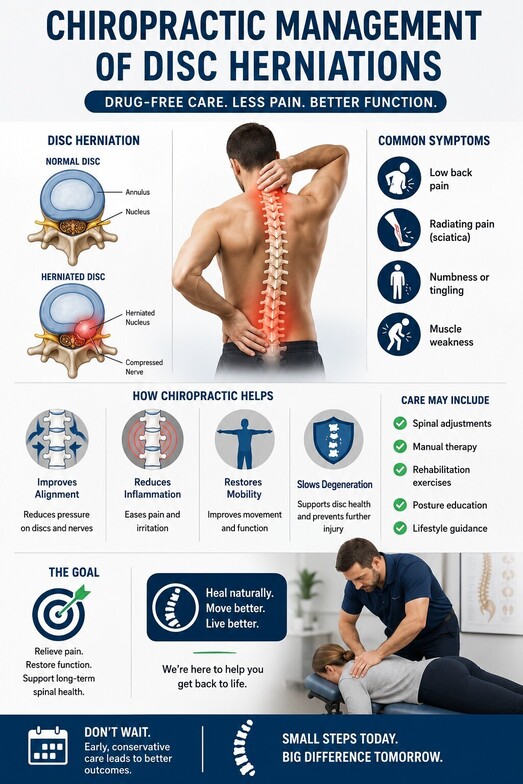
Most people think a disc herniation happens after lifting a heavy box or bending over the wrong way. In reality, the injury that causes severe back pain or sciatica is usually the final chapter of a process that has been developing for 15 to 30 years.
Research has shown that disc degeneration is a gradual biological and mechanical process. Years of repetitive loading, minor injuries, dehydration of the disc, and altered spinal mechanics slowly weaken the intervertebral disc until a seemingly minor movement becomes the "last straw." Understanding this progression can help patients appreciate why prevention and conservative care are so important.
How a Healthy Disc Works
The intervertebral discs act as the spine's shock absorbers. Each disc consists of two primary structures:
The nucleus pulposus, a gel-like center that distributes pressure evenly.
The annulus fibrosus, multiple layers of strong collagen fibers surrounding the nucleus.
When healthy, the disc allows movement while absorbing enormous forces generated during walking, lifting, twisting, and sitting.
Discs have very little direct blood supply. Instead, they receive nutrients through diffusion as the spine moves. Normal spinal motion helps pump nutrients into the disc while removing waste products, making regular movement important for disc health.
The First 10 Years: Early Wear Begins
The degenerative process often starts long before symptoms appear.
Beginning as early as the late teens or twenties, microscopic changes occur within the disc:
Loss of water content
Decreased proteoglycan concentration
Reduced elasticity
Small microscopic tears in the annulus
These changes usually produce no pain. Most people continue working, exercising, and living normally without realizing the disc is becoming less resilient.
The review published through the National Institutes of Health explains that degeneration is influenced by genetics, aging, repetitive mechanical loading, smoking, obesity, and occupational stresses. Rather than one traumatic event, degeneration is typically the cumulative effect of many years of mechanical stress.
Years 10–20: The Disc Weakens
As degeneration progresses, the nucleus pulposus loses hydration and becomes less capable of distributing loads evenly.
Instead of pressure being shared across the entire disc, certain areas begin experiencing higher stresses than others.
Small annular tears accumulate.
The disc gradually loses height.
The facet joints begin carrying greater loads.
Motion between adjacent vertebrae may become less symmetrical.
At this stage many people experience:
Occasional stiffness
Morning back pain
Episodes of "throwing out" their back
Muscle spasms after activity
These episodes often resolve within days or weeks, but they may represent ongoing degeneration rather than isolated injuries.
Years 20–30: Herniation Develops
Eventually the weakened annulus can no longer contain the nucleus.
The disc may begin to bulge outward.
With continued loading, the nucleus may protrude through weakened annular fibers, creating a disc protrusion or herniation.
If the herniated material contacts an inflamed or compressed nerve root, symptoms may include:
Sciatica
Leg numbness
Tingling
Weakness
Difficulty standing or walking
Pain that radiates below the knee
Ironically, the movement that produces symptoms is rarely the true cause.
Patients frequently report:
"I just bent over to tie my shoe."
"I sneezed."
"I picked up a grocery bag."
These activities usually represent the final stress placed on a disc that has been weakening for decades.
Why Spinal Mechanics Matter
Biomechanical research demonstrates that intervertebral discs respond to the way loads are distributed across the spine.
Healthy motion distributes forces relatively evenly throughout the disc.
Conversely, abnormal or asymmetrical movement patterns can concentrate stress on specific portions of the annulus fibrosus, potentially accelerating wear over many years. Mechanical loading also influences the biology of disc cells through mechanotransduction, affecting how the disc remodels and responds to stress.
Maintaining balanced spinal motion is therefore considered an important component of preserving normal spinal mechanics, although no single intervention has been conclusively shown to prevent disc degeneration.
Where Conservative Chiropractic Care May Help
Conservative chiropractic care does not "push a disc back into place," and current evidence does not support claims that spinal manipulation reverses disc degeneration.
Instead, chiropractic care aims to improve joint mobility, reduce pain, and restore more normal movement patterns within the spine.
When spinal joints become restricted, neighboring segments may compensate with excessive motion, creating asymmetrical loading across discs and facet joints.
By improving joint mobility where appropriate, chiropractic adjustments may help:
- Restore more symmetrical spinal movement
- Reduce mechanical stress on irritated spinal joints
- Improve overall spinal function
- Decrease muscle guarding
- Help patients move more comfortably
- Facilitate participation in exercise and rehabilitation
Researchers studying spinal manipulation have demonstrated measurable biomechanical effects, including facet joint gapping and tissue loading that remains within physiological ranges comparable to normal spinal movement. These findings suggest spinal manipulation influences spinal mechanics without producing damaging loads in healthy tissues.
Supporting the Body's Natural Healing
Disc herniations often improve without surgery.
The body has remarkable healing mechanisms that include:
- Reduction of inflammation
- Gradual resorption of herniated disc material
- Tissue remodeling
- Improved muscular stabilization
Conservative management—including patient education, appropriate activity modification, exercise, and spinal manipulation for selected patients—is recommended by many clinical guidelines as an initial treatment approach for many uncomplicated lumbar disc herniations.
Some prospective studies have found that patients with MRI-confirmed lumbar disc herniations receiving spinal manipulative therapy experienced improvements in pain and function over time. However, these studies do not establish that manipulation reverses degeneration or directly repairs the disc itself.
The Importance of Early Intervention
Waiting until severe pain develops means the degenerative process has often been underway for decades.
Maintaining spinal mobility, staying physically active, strengthening the core muscles, maintaining a healthy body weight, avoiding tobacco, and addressing recurring episodes of back pain early may help reduce unnecessary mechanical stress on spinal tissues.
Conservative chiropractic care can be one component of a comprehensive spine health strategy by helping restore movement, reducing pain, and improving function. Combined with exercise, healthy lifestyle habits, and appropriate medical evaluation when necessary, these measures may help people stay active and maintain spinal health throughout life.
References
Adams MA, Dolan P. Intervertebral Disc Degeneration: Evidence Review. National Institutes of Health (PMC3512277).
Fearing BV, Hernandez PA, Setton LA, Chahine NO. Mechanotransduction and Cell Biomechanics of the Intervertebral Disc. JOR Spine. 2018.
Funabashi M, Kawchuk GN, et al. Tissue Loading Created During Spinal Manipulation in Comparison to Loading Created by Passive Spinal Movements. Scientific Reports. 2016.
Cramer GD, et al. Magnetic Resonance Imaging Zygapophyseal Joint Space Changes Following Spinal Manipulation. Journal of Manipulative and Physiological Therapeutics. 2013.
Leemann S, et al. Outcomes of MRI-Confirmed Lumbar Disc Herniations Receiving Spinal Manipulative Therapy. Journal of Manipulative and Physiological Therapeutics. 2014.
Trace Palmer
Contact Me